Biography
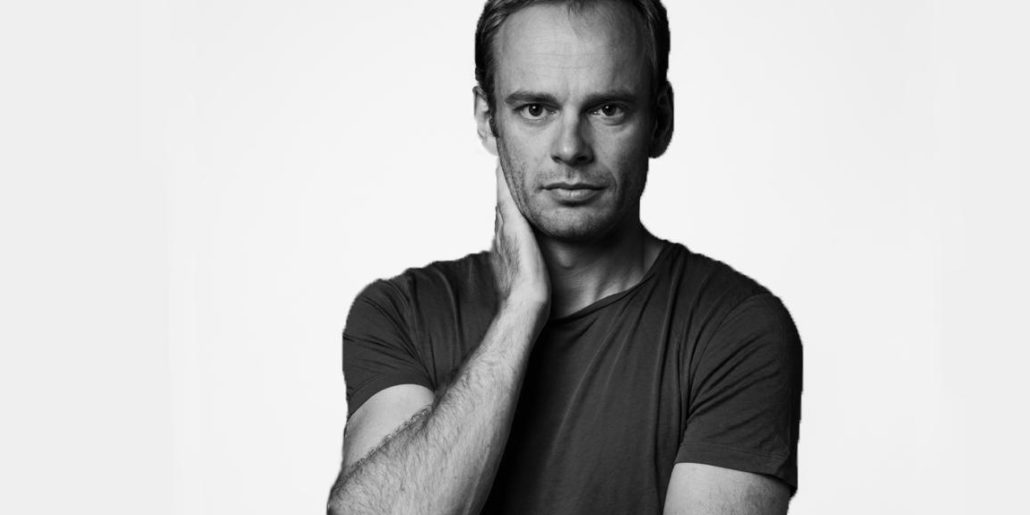
Thomas studied biology and philosophy at the KUL and dramatic art at drama school Dora van der Groen. Thomas’ work balances on the borders of theatre, dance and installation. In his recent productions, he explores the dramatic possibilities of everyday actions. His work has been described as poetic, radical, expressive and ritualistic. As a freelance actor, he regularly works for theatre, film and television.
More info
Platform 0090 – Thomas Ryckewaert
Photo: Roeltje van de Sande Bakhuyzen
In residentie GOLEM
09.12.2016 – 09.12.2016
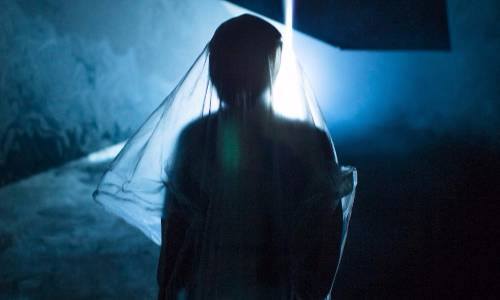
According to Jewish legends, a golem is a creature moulded from dust or clay by a scholar and brought to life by ritual incantations. The golem relates to its human creator as a helper, companion or protector of its threatened community. But the experiment is derailed: the creature turns against its creator. This myth of artificial life lies at the heart of Thomas Ryckewaert’s new creation. It is a story about ambition, creativity, power, creation, madness and destruction. It is a theme that touches on the age-old fear of creating something that outwits us: from the Bible about Frankenstein to the spectre of artificial intelligence. It is a story that asks the same question in every era: how deep can we dig?
In hushed, cinematic imagery, Golem balances on the thin line between man and matter, between reason and fear. Face to face with a creature that looks very much like him but is at the same time fundamentally different, man is shown a mirror. He sees monsters being born in things, in the other, in himself.
In residentie Chaos – making sense of an ending
02.01.2023 – 14.01.2023
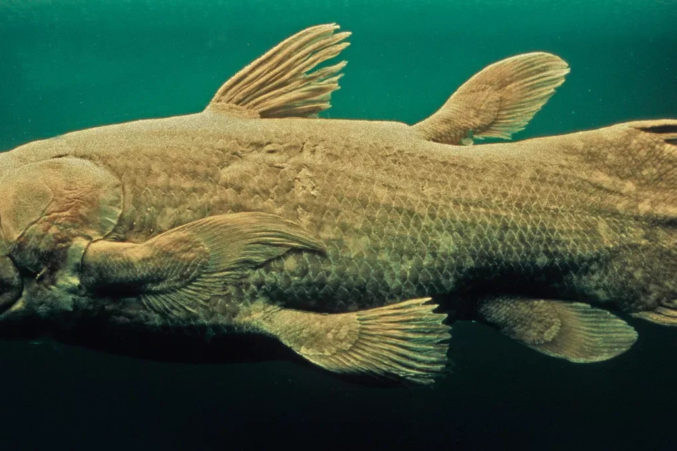
In Chaos – Making Sense of an Ending, biologist and actor Thomas Ryckewaert tries to make sense of the events of recent years: the sudden death of his father, the lockdown, ecological disasters and growing defeatism. Supported by mathematics, ecology, science fiction, diary fragments and Playstation games, Thomas battles his demons.
In Chaos, the boundaries between the intimate and the global, between the inner and outer world, between reality and madness become blurred.
Can scientific models provide relief on a confusing and unpredictable planet? Can you mourn a loved one and the end of the world at the same time? Is there poetry in theory? And what about theatre?
In residentie Annihilation
01.01.2025 – 01.01.2025
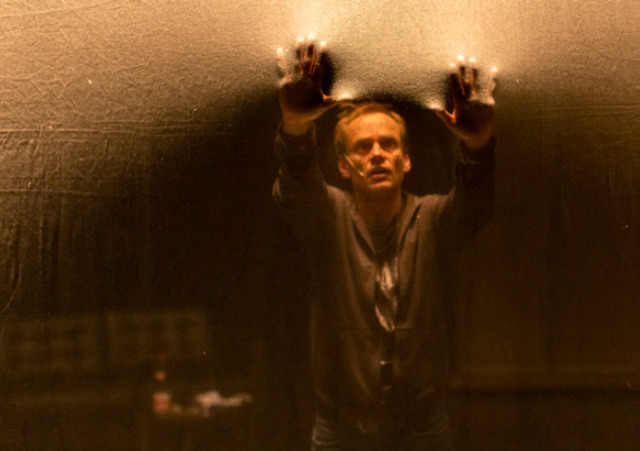
What we know is not what we desire. – Patricia De Martelaere.
Since the dawn of modern science, we have struggled to process its insights and consequences. In recent centuries, scientists have stumbled upon such strange, counterintuitive, and emotionally challenging discoveries that they sent shockwaves through our collective consciousness. A gap exists between what we know about the world and how we experience it. And that gap is widening. Recent insights in areas like cosmology, climate science, biology, and AI are unveiling or generating a reality that is becoming increasingly difficult for us to imagine. The cosmos is said to be a hologram. Artificial neural networks are becoming creative. My “self” turns out to be a neurobiological illusion. The ice caps are melting.
Facts are proving stranger than fiction. As cultural critic Mark Fisher writes in The Weird and the Eerie: “A black hole is stranger than a vampire. The way it rends space and time completely transcends our everyday experience of reality, and yet a black hole belongs to the reality of our cosmos—a cosmos that must therefore be far stranger than our experience can grasp.” How do we relate to this gap? How can we address this strangeness? How do we feel about it?
From my scientific background, I have always been interested in this gap in my theater work, and to what extent the performing arts can build bridges across it. I believe that the strange tension between what we know and what we desire holds enormous dramatic potential. As mentioned above, in my creations of recent years, I have been exploring ways to stage nonfiction. Move 37 (2019) was a lecture performance co-created with theoretical physicist Thomas Hertog and explored A.I. and black holes, in an attempt to imagine the unimaginable and to give shape to its uncanny consequences. Chaos (2023) was a solo performance following the sudden death of my father and addressed the intertwining of personal and global loss: how to grieve for a loved one in apocalyptic times of climate change, pandemics, and mass extinction. Mathematics (chaos theory) and biology were deployed in a search for solace. With this application, I want to explore, over a period of six months, how, unlike previous productions, I can start from fiction to address a strange scientific reality, how science and fiction are in tension with each other, and how the combination of the two can lead to a result that is greater than the sum of its parts.
An obvious form for this would be science fiction. But in recent years, a new literary movement has emerged that has come to be known as New Weird. This is a combination of science fiction, horror and speculative fiction that attempts to shape the strange reality we find ourselves in.